
Igor Larionov: «We want to make the season last as long as possible»
24.11.2026
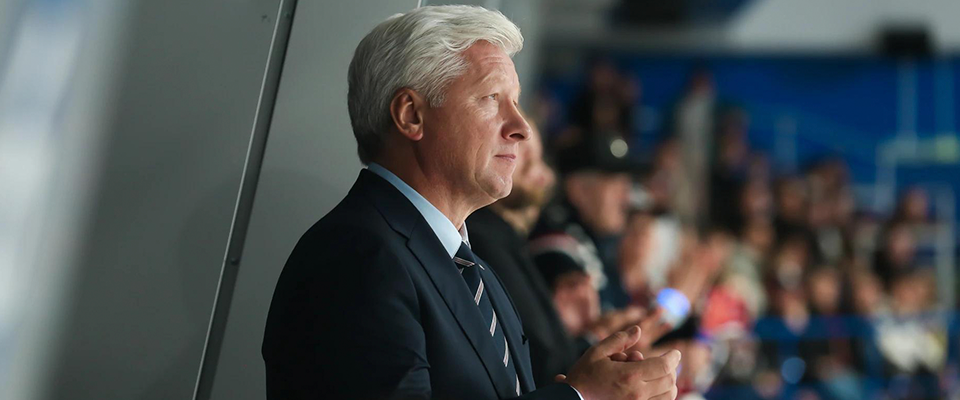
BUSINESS Online spoke with Igor Larionov, General Director of Neftekhimik. Igor Viktorovich Larionov explained why another first-round playoff exit would no longer be acceptable for the team this season, why a roster made up entirely of homegrown players is impossible to build, how the Nizhnekamsk youth academy competes with the Tatneft-backed system, and whether signing Evgeny Kuznetsov remains a live topic.
“Players and coaches were disappointed by how early the playoffs ended”
– Igor Viktorovich, Neftekhimik is enjoying its best season in years in the KHL and sits among the top three teams in the Eastern Conference. What do you attribute this success to?
– It is too early to draw firm conclusions, since less than three months have passed since the start of the season. The standings are incredibly tight. Every game in the East is a fierce battle; our current position certainly motivates the team, but the final results can only be judged in the spring. Still, we did expect this kind of performance, it is the fruit of solid, systematic work.
The team performed well last season, and over the summer we strengthened the specific positions that needed addressing. It is good that we drew the right lessons and made minor adjustments to the roster. I believe we have a strong interim result, but the real work is still ahead.
– Can the team stay among the conference leaders?
– In sports you cannot guarantee anything. Every one of the league’s 22 teams wants to play its best. We are also fighting for our place in the sun and trying to prove our caliber. I believe we are on the right track.
– Historically, Neftekhimik’s main goal for the season has often been simply to reach the playoffs. Has that changed?
– After last season, the players and coaches were a little disappointed by how early the playoffs ended. That is why this time we want to make the season last as long as possible.
“I would not call him ‘soft’.” The Grishin factor in Nizhnekamsk
– Many point to head coach Igor Grishin as a key factor in the team’s success. What makes him unique?
– He is a true professional, both in the sporting side and in how he communicates. He knows how to build trusting relationships with the players and pick the right tactics for any given game.
– Is it true that Grishin is a “soft” coach?
– Not exactly. People only see what is on the surface, Igor Vladimirovich certainly does not go around breaking hockey sticks or smashing glass. He is very well-mannered, cultured, and composed. But when it comes to the actual work, his approach is highly systematic and rigorous. I would not call him a “soft” coach.
– How do the players feel about working with Grishin?
– The atmosphere within the team tells you everything, it is always positive. When the guys feel supported by their head coach, it gives them a real boost, it builds the confidence they need to improve both their team play and their individual performance.
– How did Neftekhimik handle the contract extension talks with Grishin?
– Even during last year’s regular season we could see that things were going well. Before the playoffs began, we started discussions, learned that Igor Vladimirovich wanted to stay, and asked about his future plans. Once we realized our visions were very much aligned, we worked out the details – that happened after the playoffs concluded.
– Why did you choose Grishin a year and a half ago?
– His philosophy fit the club very well. Igor Vladimirovich knows how to work systematically; he pays attention to young players and communicates well with the team. We saw a progressive approach in his training methods and knew his track record – specifically, that he had won the Petrov Cup. For us, he was the best possible choice.
We also had players on the roster who had worked with Igor Vladimirovich before, and their feedback was positive. Our advisor for the club’s development structure, Sergey Nikolayevich Levashov, had worked alongside Grishin in Podolsk; Mikhail Sergachev is also a product of Igor Vladimirovich’s coaching. Once we gathered all these perspectives and presented our vision to the shareholders, it became clear that we were aligned in our goals.
– Do you still stay in contact with Sergachev?
– Of course. We do not talk as often these days, but we stay in touch. Thanks to his efforts, the ice rink at Lyceum No. 31, where he once studied, was renovated. We see this as an important step for hockey in Nizhnekamsk. We are grateful for Mikhail’s support, which has helped not only professional hockey but the amateur game as well.
How Neftekhimik builds its budget and works with shareholders
– How does your communication with SIBUR work? Is it true that the club has complete freedom on all sporting matters?
– SIBUR has a clear, well-defined working relationship with all its subsidiaries. We have a specific set of responsibilities, we prepare and carefully develop our plans, then submit them for approval. We do not make any major decisions without shareholder consent.
– A month ago, Match TV reported that Neftekhimik’s budget had risen to 2 billion rubles. How did you react to those rumors?
– I have not come across any such reports, so I cannot comment on those rumors.
– Every new KHL season brings a higher salary cap, between 2025 and 2028 it will rise by 150 million rubles, to 525 million min. Have you discussed this with SIBUR? Are they ready to keep supporting the team?
– Our shareholders clearly understand the need to comply with all league regulations. We meet every necessary requirement. The club is obligated to meet KHL standards, and we keep our shareholders informed well in advance. Our budget planning begins a year and a half before the start of the calendar year; it is extremely detailed, down to every line item. One key component is the salary floor, which helps us determine what our financial model will look like for the coming season.
– Right now you are not meeting the salary cap (minimum) – you are spending only 90 percent of the 525-million-ruble threshold. Why does Neftekhimik aim for exactly 90 percent? Do the KHL regulations allow that?
– Let me clarify: when a club submits its roster, it must meet at least 90 percent of the salary floor; by the end of the season, however, the full floor requirement must be met. Failure to do so brings financial penalties. In other words, at submission we use 90 percent of the floor and deliberately keep a small reserve – which we can then spend either on strengthening the roster or on re-signing players.
– Do you have that reserve available now?
– Yes, we do.
How did Belozyorov break through, and where do his contract extension talks stand?
– A year ago you used that reserve to re-sign a key forward, Andrei Belozyorov. He gets better every season and is currently among the top ten scorers in the regular season. What has driven Andrei’s progress?
– It is a combination of several factors. Of course, it comes down to his skill, ambition, and mindset, as well as the role the coaching staff gives him. I think this is a perfect example of a talented player finding the right environment – fertile ground, if you will – to keep developing.
– Does it surprise you that Andrei played in the VHL until he was 26 and only truly blossomed now?
– As the saying goes, everything has its own time. Andrei developed his potential in the MHL and VHL, but he truly blossomed only after reaching the KHL. That came down to a combination of factors: his own skill and drive, along with the support he received from the coaching staff.
– In recent years, have you had many inquiries about a possible trade or buyout for Belozyorov?
– From the outset we make it clear to other clubs that we do not intend to part with our key players. As a result, we have always found terms acceptable to both sides for extending his contract.
– Are talks with Belozyorov still ongoing?
– At the moment our sporting director, Anton Vladimirovich Marchinsky, handles most of the negotiations; I take part in the preliminary discussions and join again at the final stages. We are still in talks with Andrei – the dialogue is ongoing. We have a plan, and we are following it. I do not believe we should rush, but at the same time we cannot afford to put the negotiations off either.
– Is Neftekhimik fully committed to keeping Belozyorov?
– There is no reason to hide it, yes, absolutely – we are very interested in keeping him.
Neftekhimik’s Transfers and the Kuznetsov Question
– Before Anton Marchinsky took over as sporting director, you handled transfers at Neftekhimik. Has the market for foreign players changed, and is it harder to bring them in now?
– I would say the situation is much the same. It may have been easier to recruit foreign players in the past, but the pool of options has shrunk, and not every foreigner is willing to come to Russia.
– This summer Neftekhimik signed American player Timothy Lovell, currently the team’s only foreign player. Does he ever get lonely?
– When Luka Profaca was here, the two were close friends. Luka has since left, but it has not affected Timothy’s mood. He enjoys both the team and the city.
– Over the summer Neftekhimik had a chance to sign Evgeny Kuznetsov – Marchinsky held talks with him and offered a contract, and Grishin backed the move. What was your view on potentially signing Evgeny?
– Evgeny commands a lot of authority and has great skill. I will not hide the fact that we wanted him on our roster this summer and held serious negotiations, but he ultimately chose a different path. There is no point in discussing it further now, since our plans have changed.
– Do you travel with the team on road trips?
– Yes, but not always; my administrative duties have grown, and they require me to stay in Nizhnekamsk.
– When you are not traveling with the team, you watch games on television, where the on-screen graphics are in English. Do you understand all the terms, and do you think broadcasts should use Russian graphics instead?
– I understand the terminology and the logic behind the league’s decision to keep player names and all visual elements in English. When the KHL was founded, the plan was to reach many different countries, and English would have been understood by the majority. I am confident that the global situation will change and we will return to the international stage.
How Neftekhimik learned that HC Chelny was withdrawing from the championship
– HC Chelny was meant to be part of Neftekhimik’s development pipeline. How did you react to the news that their team would sit out an entire season?
– We were very disappointed. Everyone recognizes that Naberezhnye Chelny is a very advantageous location. The good news is that we have maintained our relationship with the club and remain in contact with HC Chelny’s management. Of course, we had to adjust our plans; we are now developing our partnership with Ryazan-VDV.
– When you signed the contract, did you know your partner club might miss a season?
– Certainly not. The decision came as a complete surprise to everyone.
– Neftekhimik is partnering with Ryazan-VDV for the coming year. Do you rule out returning to an arrangement with HC Chelny in a year or two?
– We will cross that bridge when we come to it. Circumstances will likely change for everyone by then, so we will decide based on the situation at that time. To reiterate, we have maintained a positive, cooperative relationship with HC Chelny, and our collaboration with Ryazan-VDV is also going well.
How many homegrown players does Neftekhimik want on its roster, and why does the club continue to support a junior draft?
– Neftekhimik has two ice rinks: one in the main arena and one in the secondary arena. Is that enough, given that you have to accommodate the first team, the MHL (Junior Hockey League) squad, and about a dozen youth age groups?
– It is sufficient. We have a decent amount of ice time, although the secondary arena has to serve 13 youth age groups, and games are also held there on weekends. We also give our youth teams access not just to the ice but to our sports and game halls – whenever they are free, our youth academy players use them for training.
On the other hand, we would like more opportunities for specialized development groups – for goaltenders, defensemen, and forwards across both younger and older age categories. But we make the best of the conditions we have. After all, beyond the training sessions themselves, we also have to clean the boards and glass and prepare the ice – tasks that take up a significant amount of time.
– What do you see as the main measure of how the whole “Neftekhimik” system is performing?
– The club’s work has to be judged on several criteria: the KHL team, the MHL team, and the youth academy teams. Everything should serve team success and the individual development of players, starting from a young age.
Seeing our own homegrown players on the first team is an important milestone for both the club and the city. We want the children training in our system to feel proud of Neftekhimik. That is why our homegrown players – those who have reached our KHL first team or even the NHL – are excellent role models for the kids in Nizhnekamsk.
– The current Neftekhimik roster includes four homegrown players who are regulars – Nikita Khoruzhev, Yaroslav Ozolin, Sevastyan Sokolov, and Rafael Bikmullin – along with players promoted from Reaktor. How many homegrown players would you like to see on the roster ideally?
– We understand realistically that it is impossible to build a roster made up 100 percent of homegrown players. We do not set specific KPIs or quotas for how many of our own players must be on the first team. Our homegrown players have to compete for their places against players brought in from other teams, strictly on merit.
We are always proud of our homegrown players, though, wherever they play. We are always glad to see them return to our club. We keep in touch, offer our support, and always welcome them respectfully when they come back to our arena as members of opposing teams.
– What is the likelihood that in a couple of years “Neftekhimik” will have eight or nine homegrown players on the roster instead of four?
– Let us not get ahead of ourselves. We do all we can to ensure there are as many of them as possible, but a place on the roster is earned by athletic merit, not by birthplace.
– By the way, a year and a half ago Neftekhimik called for the creation of a junior draft. What is your position now?
– My position has not changed. Given the specific character of our city, it is harder to recruit young players here than in larger cities. In those places there is an abundance of children, which means not every young player gets the chance to develop. We would offer that chance and help them grow. In our view, a junior draft would be good for everyone.
– Is there competition between the Neftekhimik hockey school and the Tatneft Arena in Nizhnekamsk – formerly known as TANECO Arena?
– Yes, there is. When the arena was being built, I said that competition benefits everyone and drives progress. The only problem is that player selection in our city is harder – it comes down to recruiting whoever is available. As a result, we have fewer options to choose from. That said, there is healthy competition between the two Nizhnekamsk schools during tournaments.
– Does that force you to offer something your competitors do not?
– Of course – that is the nature of competition. In my view, we compete more successfully because we have greater access to ice (two arenas instead of one), and we have made training sessions free for our youngest age groups, while they charge fees there.
We also provide basic equipment – skates, helmets, and sticks – for newcomers, which makes it much easier to start in hockey. Not every parent can afford to equip a child when they do not yet know what the child’s future in the sport might be.
“We have set a goal of raising attendance to 90–100 percent”
– This season, reports surfaced about a possible change to the Neftekhimik logo. What prompted it?
– It is our own initiative, backed by our parent company. We belong to the large SIBUR group, which has its own principles and vision for the club’s development. It is encouraging that the company takes such a close interest in our work; we are working together on the club’s digital transformation. We are currently testing a new logo – part of an effort to revamp how we engage with our audience, both in Nizhnekamsk and beyond – as a symbol of the systemic changes we are starting, and we are gauging the fans’ reactions.
– So, are more changes planned?
– Yes, it is a comprehensive program covering both internal and external changes. That includes updating the arena interior. We are also putting a strong emphasis on fan communication and stepping up our social media activity. We have clear, well-defined goals for increasing spectator engagement and boosting attendance.
Our shareholders – the SIBUR group of companies and Nizhnekamskneftekhim – fully support our initiatives. On November 14, with the company’s backing, we hosted an “Eco-game” as part of the citywide “Green Light” environmental program.
Together with the city administration, we have developed a roadmap covering our efforts both in the city and across the Zakamye region. Our goal is to create a comfortable environment for spectators and make every hockey game a celebration.
– What arena occupancy rate are you aiming for?
– This season we have seen everything from sold-out arenas to games with lower attendance. You have to take factors into account such as seasonality, the frequency of home games, and the team’s level of play. We have set a target of 90–100% capacity within two to three years. This is not something that can happen overnight – it requires extensive, systematic work.
Source: BUSINESS Online