
Daniel Sayapov: «The most important things are desire, reliability, and hard work»
31.03.2026
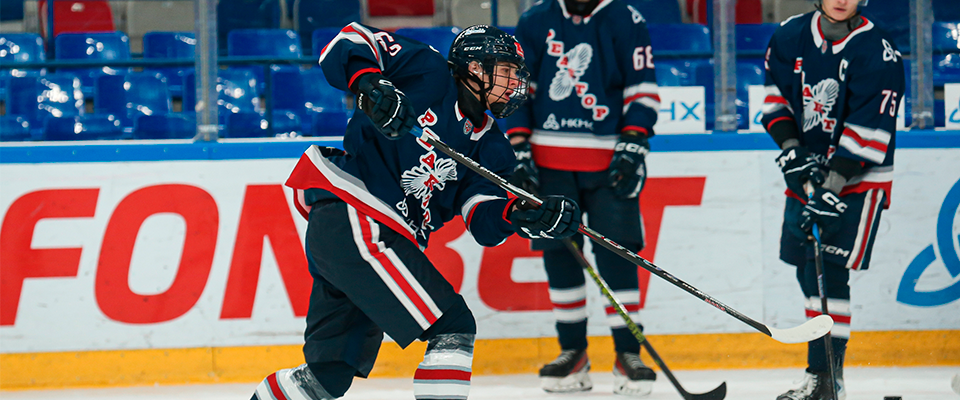
Reaktor defenseman Daniel Sayapov talsk about his first JHL goal, hobby and the difference between the YHL and the JHL.
– Daniel, what's it like being 16 and playing against 20-year-olds?– It's always nice to play against older guys. You feel your progress – it's really cool and wonderful. Of course, it's physically challenging because the guys are all getting bigger and more mature, but we also train and do physical training.
– What was your path in hockey?
– I started playing hockey very early – at three years old. It all started when my parents and I went to a hockey game, and I liked it. It was a Salavat Yulaev vs. Atlant game. I joined a hockey team and played my senior year. After that, I ended up at Neftekhimik, and then at JHC Reaktor.
I talked to the guys from the 2009 Neftekhimik Hockey Schoo team. They said they needed help. I came here, and that's how it all came together.
– What challenges have you or your family faced along the way?
– When I was still playing in Ufa, there was a period when I couldn't make the team for a long time. Through hard work, and a fair amount of luck, everything worked out for me.
– Did you ever want to quit?
– No, I never did. I love hockey so much... I couldn't live without hockey.
– Did you set a goal of making the Reaktor roster before the season?
– That's always the highest goal. It was one of them. I actually set that goal for myself, but I didn't think I'd end up on the team. I want to say a huge thank you to the coaching staff, the coaches at the Hockey School, who set me on the right path.
When I first joined the team, Andrei Nikolayevich Zharenkov and Artur Maratovich Sarvarov were coaching. Then Artur Maratovich Sarvarov became the coach of the Junior Hockey League, after that I was selected to play my senior year. I'd also like to say a big thank you to him and Andrei Nikolayevich.
– How did it feel to sign the contract?
– That was delightful! I didn't expect that at all. They called me and said I should come over and sign. I was in shock. It took me two or three days to get over it. Well, it was an unforgettable feeling. I called my parents, and they were happy for me. They said it was a small step on a long journey.
– Now let's talk about the difference between the YHL and the JHL. What was the first thing that you noticed?
– I noticed the speed of decision–making process. No one is turning the puck over, everyone is fast, and everyone is also very strong. So you have to adjust to the speed, fortunately, we have good training – in just two months, I was able to adjust to the level of the JHL guys.
– Have you adjusted?
– Yes, I think I've already adjusted to the league. I'll try to improve my game and become a leader. What advice can I give to guys who are new to the league? I think it's best to start playing simple, with short shifts. Never be afraid of physical play. Physical play really helps you mentally get into the game faster.
– This is your first JHL season, you played 11 games, scored 3 points (1+2), got +4 (+/- rating) and only 2 penalty minutes. How do would you rate your first season?
– I think it's better for the coaches to rate this result. I can only say that I'm generally pleased with the way I played. I think it'll get better. Is it hard to get a good +/- rating? We have a good team, good forwards who score goals often. So I don't think it's that hard if you play in a right way. I don't play penalty kills that much. Little by little, the coaches are gaining confidence in me, but the older guys are spending most of the penalty kill.
– Do you remember how you scored your first point and first goal?
– The first point I scored in the game against Krylya Sovetov (Reaktor vs. Krylya Sovetov, 3–1, February 13, 2026). It was awesome! We also won the game. It was my second game in the JHL.The emotions from the first goal were a bit rushed. We were losing the game, with five minutes left. There wasn't much joy, because the team's result is more important to me than my own points.
How did I score? Kirill Stolyarov made a good pass. I just had to make a shot. The goaltender lost sight of the puck.
– What school do you go to? How are your grades?
– I go to school number two in Nizhnekamsk, like all the kids who come from other cities. My academic performance leaves much to be desired. I try not to miss school; we come whenever possible and study.
– Do you have a hobby besides hockey?
– Not really. Like all hockey players, I like playing PlayStation – NHL, FIFA. I also really like history. I read different books, for example, studying the history of World War II. I even participated in the School Olympics before.
– What movies, TV series, and music do you like?
– I like different kinds of music. I don't have much time to watch TV series, but I like Russian ones, mostly about sports. The last movie I rewatched was "Coach." I don't think I can single out a particular favorite.
– Which Russian defensemen and international hockey stars do you look up to?
– If we talk about the Russian defensemen, I like Mikhail Sergachev. His combination of reliability and offensive skills are quite good. This is very important for a defenseman. I also really like Damir Sharipzyanov in the KHL. He's a great player and two–way defenseman. They both come from Neftekhimik. Well, it's a coincidence, really. Apparently, Nizhnekamsk produces some very good defensemen.
– Who was your favorite player when you started playing hockey in school?
– When I started playing for Salavat Yulaev, my favorite player was Linus Omark. What about Grigory Panin? Panin is a good defenseman, he takes a very good approach to his physical training. To maintain such a high level at 40 years old—that's truly remarkable.
– How do you approach training and nutrition?
– Since childhood, my parents taught me not to eat a lot of sweets, and I never really had a problem with nutrition. As soon as I realized I needed to move up to the professional level, I started monitoring my calories, proteins, fats, and carbohydrates.
– What would I tell guys who want to make it into the JHL?
– The most important thing is to not be afraid. Reliability is also important quality for a defenseman. The most important things are desire, reliability, and hard work. Without effort, nothing comes; with effort, everything comes.