
Vsevolod Favrichnikov: «I want to thank my parents»
30.04.2026
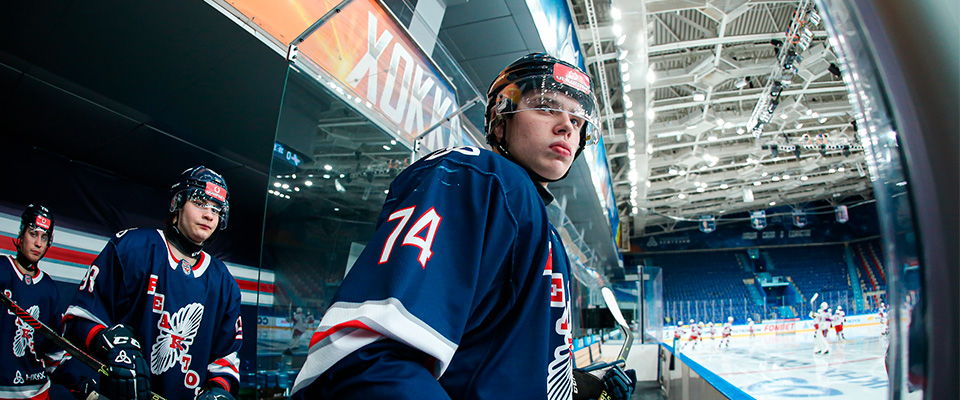
Last season Reaktor defenseman Vsevolod Favrishnikov finished second in the league in blocked shots – 134. In this interview, Vsevolod talks about the dangers of playing hockey, why he became a defenseman and his first professional contract.
– Vsevolod, is 18 a turning point in hockey? How would you rate your your hockey career now?– Sure. this is the time when you have to prove yourself and make it to the big leagues, to move from the JHL to a stronger league like the VHL or KHL. While I haven't made it anywhere yet, I'm currently recovering and trying to prove that I can play next season in the KHL.
– How did you decide to play hockey?
– My parents, my brother, and my grandfather took me to the rink for the first time when I was three years old. That was the first time I put on skates. My older brother was a hockey player, so they decided to put me in hockey too.
– Your brother's a forward. Why did you become a defenseman?
– Actually, at first, I was a forward, but then a funny thing happened. We had a practice and played some hockey. I was on the same line with defenseman Islam Davletshin, who's now on Sputnik team. I was a forward. It so happened that he'd often joined the attack and I had to work for him in defense. I was doing well, so they switched our positions. That's how I became a defenseman at eight years old.
– Were you upset?
– No, I was not. It's easier to play defense than forward. In order to make it to the big leagues, you need to be quite productive: score goals, make assists. A good defenseman is valued for his consistency and execution of several components. For example, starting a breakout and winning puck battles. But consistency is most important.
– Do you remember signing your first professional contract?
– We were driving home from a preseason tournament in Magnitogorsk, and the team group received a message that several people were supposed to report to the HR department the following day. We knew what was happening right away. I was probably one of the happiest people on the planet back then. After signing, I immediately called my dad. When I got home, all my relatives supported me, telling me I was doing well and should not relax.
– Last season you made your debut at Reaktor and statistically speaking, it was a good one for a stay-at-home defenseman. Are you a stay-at-home defenseman?
– In hockey school, I was focused to play more offensively, helping the forwards. I was able to play both defense and offense. In the JHL, I had to step up to a different level; it was much tougher. There, you have more skilled guys on the ice playing against you. Scoring points is tough, especially for a defenseman.
– Was this season a breakthrough for you?
– I feel like I've grown as a hockey player since my first season. I've improved a lot in just one year. I scored twice as many goals as last season (laughs). I'm no longer afraid of making mistakes, and because of that, I've been able to do better. I've been doing what I know how to do.
– What prevented you from finishing the season?
– I got injured at the beginning of the season in Chelyabinsk. There was an unpleasant moment during a fall. My arm was in such a position that my shoulder snapped hard. I continued training. When I returned to Nizhnekamsk, the doctors did everything that was necessary to determine whether the injury was serious or not. It turned out I had a torn joint.
After that, I talked to the coaches, the doctor, my brother and my parents. I decided I wouldn't finish the season for treatment. I didn't want to quit the team. I decided to play out the season. Unfortunately, it didn't work out – I permanently injured myself in Omsk. My arm became less mobile and began to hurt. I was hospitalized and then sent to Kazan for surgery.
– You're second in the league in blocked shots. Aren't you afraid of blocking shots?
– I don't know, I've kind of gotten used to catching pucks since hockey school times, you know, helping the goalie. Because I'm confident that when I block the shot, it won't go in. It's not scary, because at that moment I know we won't concede a goal.
– What do you think when the opponent shoots?
– Actually, when you block the shot, you don't think about anything at all. Honestly, I only have one thought: hit me instead of net, so it doesn't reach the net. That's all. I don't even think about covering my face. You know, that's hockey. My brother explained that you should never put your hand on the outside when you're catching it. You need to keep your palms forward, because if the puck hits the back of your hand, it could break your hand, and your palms are muscled, so it won't even reach the bone.
– Do you remember your first goal?
– We were playing against Avto back then. It was November 6th, right before my birthday. We hit the ice, as always, fired up for the game and determined to win. Things were a bit rough at the start. Then, as I recall, Kondrat Reshetnikov scored two goals. My goal was the game–winning one. It was a very tense game. We were coming out of the zone, I think we were playing 4-on-4. Seva (Sevastyan) Sokolov entered the zone and passed the puck to me from halfway down the boards, toward the blue line. I skated so well under him that I was in perfect position to shoot. After thatI made a shot. Igor Viktorovich (Fyodorov) later joked about this goal — beacause I I scored after two rebounds. You know, a goal is a goal.
– Yesterday there was a graduation at the Neftekhimik Hockey School. Do you remember yours?
– Of course, I remember. There were even some kids who graduated a long time ago, when they were 13 or 14 years old. We all stay in touch and help each other.
– What did school teach you?
– They taught me proper skating there. They taught me how to play defense in a right way, how to start a breakout. Basically, everything I know is entirely thanks to the coaches at the Hockey School.
– Do you have a hobby that few people know about?
– I'm studying at a teacher training college, and I want to become a coach. So hockey will never leave my life. I have this desire to pass on my knowledge to the next generation.
– What movies, TV series and music do you like?
– I prefer Marvel movies, movies about superheroes. I can listen to whatever music is playing in the locker room. When I'm getting ready for a game, I bring my headphones and turn on my playlist, which gets me fired up for the game.
– What's your strangest habit?
– I don't know, probably doing everything three times. Well, for example, when I wash my face, I always wash it three times. When I work out at the gym, I do everything three times, when I run somewhere, I always do three sprints three times.
– What would you like to remember in 5, 10 years?
– I'd like to remember playing my first KHL game.
– What did you believe in as a kid, but it turned out to be a lie?
– That everything in this world comes so easily. I used to think that I'd finish hockey school and everything would come right away. But it didn't work out that way. There's a saying: through adversity to the stars. Only through hard work you can achieve anything.
– Which Russian defenseman and international hockey star do you look up to?
– Misha Sergachev. He played a year with my brother. I try to play the way he plays. Among foreign players, I like Quinn Hughes, Cale Makar, John Carlson, and Evan Bouchard. They're more offensive-minded defensemen.
– Who was your favorite player when you started playing hockey?
– My brother.
– How scared would it be to disappoint someone close to you if you stop palying hockey?
– I don't want to upset my parents. They invested so much effort and money into it. I even felt like they were down to their last penny, but they invested everything in me and my brother. My brother didn't make it in hockey, and now all I have left is hope for a better life (smiles). I want to thank my parents, get a big contract, and give them everything.
– How much pressure do your own expectations put on you?
– Sometimes you get so overwhelmed that you start to burn out, thinking that my only goal is to make it to hockey, and if I don't, that's it, my life is over. I haven't even thought about what will happen after hockey, because all my energy and money go into it, and I'll do everything in my power to get there.
– Do you have a backup plan?
– To graduate and become a coach. Before that, I want to go through some hockey history of my own, so I have more experience and get a feel for it all.
– What would you say to guys who want to make it to the JHL?
– Well, I have nothing new to say. It's a simple matter of work. You have to balance everything properly, meaning you can't just throw yourself into hockey so you don't burn out. You can't just train seven days a week and do nothing else. It can get really boring, so you need to prioritize. You need to take breaks from hockey, relax properly, spend time with friends and study. Then everything will work out for you guys. Most importantly, you need to work hard to achieve something.