
Igor Borodinov: «These words help a lot»
17.08.2024
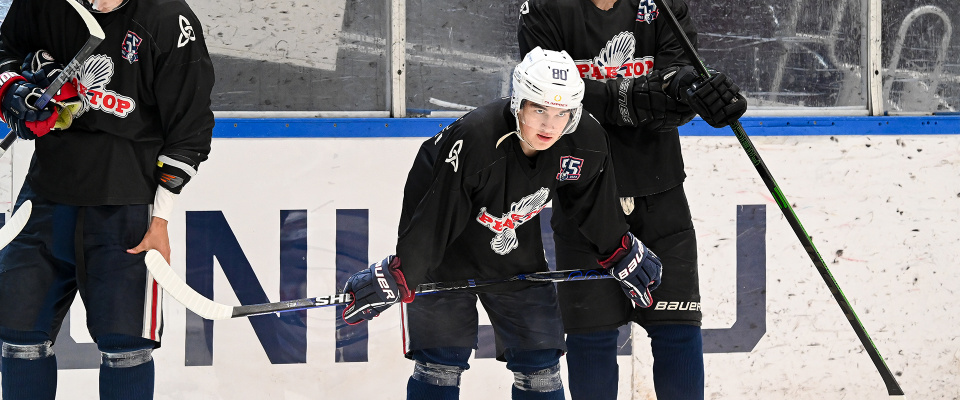
19-year-old Reaktor forward, alumnus of the Neftekhimik Youth Sports School Igor Borodinov is starting his second season in the JHL. In an interview, he shared his thoughts on sports, career, and his family. In the conversation, he talked about how he started playing hockey, what difficulties he had to overcome on the way to success, and how he copes with stress.
– How did you start playing hockey? What are your first memories?
– My dad liked to watch different sports on TV in the evenings. When hockey started, I would immediately run up, take a regular stick, and start repeating after the hockey players, as if I were also in the game. But when football or basketball was on, I showed no interest. Dad noticed this, and on my birthday, when I turned five, I stood on the ice with older guys for the first time. I started skating with a walker along the rink. That's how I learned to stand on skates, because there were no recruitment for our age at the hockey school yet. And when our Neftekhimik Youth Sports School opened for the class of 2005, I immediately came to the classes.
– You are a graduate of the Nizhnekamsk hockey school, coach Viktor Fedorovich Lyalin. There were many guys with you who are now playing in the MHL and KHL. What do you think your mentor did, giving the guys such a good push and a foundation for a future in sports?
– Viktor Fedorovich gave us a huge push by being sincere and honest with us first of all. He wanted more from us, so that we would not stop at what we had achieved, so that we would always progress, work more. He always said that the training process with the team is only 20%. He gave a lot of advice. If he saw someone in a bad mood, sullen, he called him to the coaching room for a talk, he wanted to help. Viktor Fedorovich was our second father and at the same time a psychologist. And it was obvious that he believed in us. Even now, after graduation, we keep in touch with him, and he watches us, worries. When we meet, he gives tips on the game and encourages us. For this, all of us, all of his students, are very grateful to him, he played a huge role in our sports career. All the nerves that he gave us, it was not in vain.
– Which game in your sports career left the biggest impression?
– I remember this match well. We played in the YHL with Ak Bars, already towards the season finale. Just at that time, someone from the team was already being taken to tryout at Reaktor. Unfortunately, we lost 4:5, but I scored four goals. I think it was this match that gave the impetus that I was taken to the youth team.
– Last season was your first in the MHL. What do you remember about it?
– The season was remembered primarily for our team. I was immediately accepted to the team. The season was positive, although there were mistakes in the game, but I think this will be a lesson for me in the future and will only be a plus. I got new experience. I am grateful to the coaches, because at the very beginning I was not in optimal physical shape, they all gave me a chance in the MHL. I will do my best not to let them down this season.
– What skills do you consider the most important for a successful hockey player?
– Game thinking is the most important. During the game and training, you must see the situation in advance, understand when the puck will come to you and what you will do with it next. Without this, you cannot become a hockey player, especially a good hockey player. Because your head must always work, with or without the puck. And the rest can be made up for. Game thinking is either given or not.
– What does your typical training day look like?
– Getting up around 8-9 am. Then we go to breakfast - usually cottage cheese, porridge, eggs, cheesecakes - something like that. Now we are already recovering from the loads, preparation for the season is underway smoothly, we are developing tactics on the ice. We have a warm-up on the ground, then 2 hours on the ice. The first hour we practice wrestling, throws. And in the second part - exit from the zone, tactics, majority-minority in fives. We develop teamwork. After the ice we go to the gym - balance exercises, explosion, sometimes weightlifting - all to make it easier on the ice. Then we go to lunch. And in the evening we get together with Andrey Eremenko, Ilya Slepkov, Mark Marchinsky and Vanya Birdychkin, Timofey Urakov, walk, have a good time. Sometimes we play curling iron in the dorm. We try not to lie on the bed the whole evening. Around 11 pm we have lights out, preparation for the next working day begins.
– What exercises or training do you like the most?
– I think any training session is interesting and useful if it is positive, everyone will smile - the team and the coaching staff. And it is not any other way for us. When training sessions go well, everything works out. This time we have a great team again. There is no guy who skates with a sad face. We support and encourage each other so that the loads are easy and only beneficial. Everything is on the upside.
– How do you cope with physical and psychological stress?
– If you take my first season, it was a little difficult to psychologically adjust because the environment changed. Everything comes from the team, it helped me get used to a new way of life. There were some unsuccessful moments, but we talked a lot, discussed, and it became easier. My parents also supported me when they noticed that communication had changed. They live in another city, we are in touch, so everything was easier to overcome. And as for physical stress - we have been living like this since we were five. Now everything is more difficult, but as Igor Viktorovich, our senior coach, says: “If you want to go further, to become a successful hockey player, then in those moments when it seems that you can’t do it anymore and it’s hard for you, you have to swallow your own throat and do it. If it works out, then everything will be great. You have to understand that you are working only for yourself, building your foundation.” These words help a lot, you just have to be patient and work. All this will pay off someday.
– How is the process of forming a new team going now?
– I think it’s going great. There are many guys left from last season, there are many new guys with us from our school "Neftekhimik", whom we have also known for a long time. I have never noticed any serious quarrels or gossip. The coaches also notice this, so they are happy. When everyone is positive in the team, the result will not be long in coming. I give our team an A+. Even take our training camp at the "Almash" base, when the young guys just arrived, it was clear that they were a little uneasy. And we, who have already gone through this stage, and Igor Viktorovich also explained that everything is fine, and there is no need to worry about mistakes, everyone was here for a reason.
– How do you resolve conflicts or disagreements within the team?
– There are almost none. Only minor ones. But if this does happen, we immediately find a compromise so as not to offend anyone. Everyone tries not to bring the situation to a serious offense or conflict. We are on the same level, despite our age and time on the team.
– Do you have any traditions or rituals before games?
– Yes, there is. When we warm up on the ground before the game, for example, without playing "skin", and if we win, then the next warm-up will be the same. Personally, my rituals are that I don't put my stick down with the hook down, so that the tape doesn't get dirty. I also hang out after the warm-up on the ice, and after each period, so that I go out for the first shift with a clean tape. I don't know why, as if everything goes better after that. Some guys read a prayer before the game. I haven't noticed anything else like that.
– What do you like to do outside of hockey?
– Usually, outside of hockey, I like to spend time with my friends. Since my parents are not in the city, my friends and I go for walks, we can go somewhere to eat. Sometimes I can go to the village to my grandfather, I spend time there quietly, in a good way.
– How do you maintain a balance between studying and sports? Where do you study?
– I study at the Nizhnekamsk Pedagogical College, I have already completed my third year. Ilya Slepkov and I entered together, so I will tell you about our joint balance between study and sports. In the first year of study, we were still playing in the JHL, training was in the evening, so we studied as usual. When we got to Reaktor, the teachers met us halfway and gave us free attendance, for which I am very grateful to them. When possible, we come once a week or once a month, but we receive assignments and do them at home in the evening. We come and take exams at the end of the semester. We study in the Physical Education specialty, there are many athletes studying there, and the teachers understand everything. They also come to our matches, root for Reaktor, support us.
– Who supports you in the stands? Your main fan?
– My family, although they are not in the stands. They watch every Reaktor match, they are very worried, I feel it. Therefore, it is much easier to play when you know that they believe in you. It gives a big boost, gives additional strength. I can't let them down, they put their whole soul and nerves into me, now I have to show that it wasn't in vain.
– How does your family support you in your sporting aspirations?
– If it weren't for them, I wouldn't be where I am now. Since I was five, when I started playing hockey, everything else faded into the background. They've dedicated all their time to me and my sport, they don't miss a single match. We're always in touch. Thank you, Mom, thank you, Dad. I love you very much, I hug you tightly, I love you, I miss you, taking advantage of the moment, I send them my best regards. I ate, I slept, everything is fine.